
Don't you hate it when "black hat" artists grab your articles and reprint them by flattening all your live links and then, to add insult to injury, INSERT their own RANDOM affiliate word-links to the text?
I have no idea why they do it because the result is a terrible stupid piece of text with an impossible URL.
Here is an example how one of my articles was butchered in this fashion:
http://deaqzhjrymekk.blogspot.com/2008/07/3rd-big-myth-of-search-engine.html
The URL is impossible because it is randomly generated by a black hat BLOG GENERATOR software. Not only the URL but the "name" of the blogger is also randomly generated.
And the sad thing is there is practically no defense against this kind of pirating. If I flag this blog and pursue the matter it will be deleted but 10 or 30 more will crop up before they even do so. It's a no-win fight up the cyber creek.
So what do I do? I insert my own "thank you" comments with my live link thinking "if a spider follows the links on this page it just might follow mine too and get me some Google-love"... yet I also know that it is a highly unlikely outcome.
So why do these pirates keep generating these random blogs by reprinting people's articles (most of the time published on sites like Ezine Articles) ? Because they are greedy and inexperienced and they really think they can make some money out of these totally bogus blogs. All they do is pollute the Internet.
USEFUL TIP: To catch such pirated and butchered "editions" of your articles just create a Google Alert account with your name as the keyword. Every time one of your articles is published on the Internet you'll receive a Google -email. Very easy to keep track of. The results may just amaze you.
Monday, July 14, 2008


Tuesday, June 17, 2008
Monday, June 16, 2008
How Not to Design a Squeeze Page
I did not make this one up folks. This one is for real and is an excellent example of how NOT to design a squeeze page, especially one set up to sell a very expensive web-based service.
The rule is -- the more information you ask from your prospective customers upfront, the lower will be your conversion rate.
How many people do you think have signed up for this "Free software demo" by providing all the following MANDATORY information (all the fields with asterisks)?
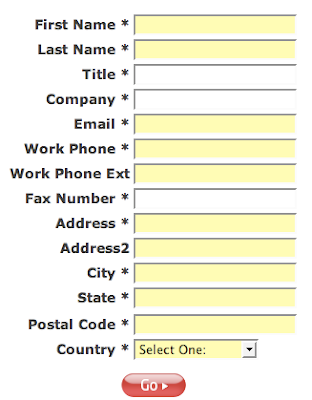
What were they thinking?
You have to be really desperate for this software in order to provide all that MANDATORY information before allowed to watch the demo.
The kicker is, they won't tell you WHAT exactly their "service" is all about either. No. You have to give them all that information about yourself (including your FAX NUMBER) and THEN, and only then, they will allow you to have a peek at what they've got.
Good luck!
Rule of thumb: if you'd like to have a good conversion rate, ask no more than NAME and EMAIL address. That's it. Some people are so hungry for your e-mail that they even skip the name.
P.S. The cost of this service that you cannot even sample before giving up all that information is $5,000 upfront for "set up"; and then $300 recurring fee every month. So I guess they are interested only in people with really a lot of cash and a lot information to give up. I hope that strategy is working for them.
The rule is -- the more information you ask from your prospective customers upfront, the lower will be your conversion rate.
How many people do you think have signed up for this "Free software demo" by providing all the following MANDATORY information (all the fields with asterisks)?

What were they thinking?
You have to be really desperate for this software in order to provide all that MANDATORY information before allowed to watch the demo.
The kicker is, they won't tell you WHAT exactly their "service" is all about either. No. You have to give them all that information about yourself (including your FAX NUMBER) and THEN, and only then, they will allow you to have a peek at what they've got.
Good luck!
Rule of thumb: if you'd like to have a good conversion rate, ask no more than NAME and EMAIL address. That's it. Some people are so hungry for your e-mail that they even skip the name.
P.S. The cost of this service that you cannot even sample before giving up all that information is $5,000 upfront for "set up"; and then $300 recurring fee every month. So I guess they are interested only in people with really a lot of cash and a lot information to give up. I hope that strategy is working for them.
Sunday, June 15, 2008
Critically Scarce"?
Can something be "scarce" but NOT "critically scarce"?
From New York Times (June 7, 2008):
"... housing was critically scarce along the Gulf Coast after Hurricane Katrina."
?
This is like saying "the house was painted green in color." Green is the color, and what's scarce is by definition "critically" so.
It's enough and more proper to say something is painted green, period; or that the housing is scarce. Full stop.
From New York Times (June 7, 2008):
"... housing was critically scarce along the Gulf Coast after Hurricane Katrina."
?
This is like saying "the house was painted green in color." Green is the color, and what's scarce is by definition "critically" so.
It's enough and more proper to say something is painted green, period; or that the housing is scarce. Full stop.
Saturday, June 14, 2008
Non-Parallel Construction
Even important publications like NYT or WSJ are not immune to generating weak prose, constructed with non-parallel clauses.
Here is one from New York Times (June 7, 2008):
"The hunger strike is meant to pressure federal officials, and comes as Congress is debating an expansion of the guest worker program..."
There's nothing "wrong" with this sentence except a passive-voice clause is followed by an active-voice one.
This is how I'd edit it:
"The hunger strike aims to put pressure on the federal officials, and comes as Congress is debating an expansion of the guest worker program..."
Here is one from New York Times (June 7, 2008):
"The hunger strike is meant to pressure federal officials, and comes as Congress is debating an expansion of the guest worker program..."
There's nothing "wrong" with this sentence except a passive-voice clause is followed by an active-voice one.
This is how I'd edit it:
"The hunger strike aims to put pressure on the federal officials, and comes as Congress is debating an expansion of the guest worker program..."
Friday, June 13, 2008
Scheduling Posts
Now you can schedule your posts in advance if you are using Blogger.
WordPress had that functionality for quite a while.
I congratulate Blogger for the innovation for a good reason -- whenever I had WordPRess blogs they've been assaulted without mercy by comment spammers.
With Blogger, knock on wood, that has never been an issue and I'm using Blogger since year 2000. I hope one day WordPress developers will also learn how to protect their bloggers against such nuisance.
Something new -- if you're looking for an HTML editor which has a built-in advance scheduling function, try Xsite Pro 2.0. It is the only HTML editor I know (not Dreamweaver, not GoLive) which allows you to schedule your web pages in advance and publishes them according to your schedule. Indexing robots love that time-release stuff.
WordPress had that functionality for quite a while.
I congratulate Blogger for the innovation for a good reason -- whenever I had WordPRess blogs they've been assaulted without mercy by comment spammers.
With Blogger, knock on wood, that has never been an issue and I'm using Blogger since year 2000. I hope one day WordPress developers will also learn how to protect their bloggers against such nuisance.
Something new -- if you're looking for an HTML editor which has a built-in advance scheduling function, try Xsite Pro 2.0. It is the only HTML editor I know (not Dreamweaver, not GoLive) which allows you to schedule your web pages in advance and publishes them according to your schedule. Indexing robots love that time-release stuff.
Thursday, June 12, 2008
Technical Editing
EXAMPLE: Once the startup condition is attained, the user can launch the module.
BETTER: After starting the system, the user can launch the module.
Wednesday, June 11, 2008
"Energizing"
Some of the worst excesses of copy writing give the trade a bad name.
Take the following lonely adjective I noticed printed on the label of a bottle of shampoo:
"Energizing..."
Now what the heck does that mean, really?
Energizing WHAT? Does it mean I'll have more energy when I use that shampoo? Of course not.
How much more energy we're talking about? Are we talking in terms of Calories?
Etc. Etc.
Total nonsense and yet someone was paid to write that, and another to place it on the label.
When I see empty rhetoric like that masquerading for good writing, I feel like breaking my keyboard and selling used cars for a living.
Take the following lonely adjective I noticed printed on the label of a bottle of shampoo:
"Energizing..."
Now what the heck does that mean, really?
Energizing WHAT? Does it mean I'll have more energy when I use that shampoo? Of course not.
How much more energy we're talking about? Are we talking in terms of Calories?
Etc. Etc.
Total nonsense and yet someone was paid to write that, and another to place it on the label.
When I see empty rhetoric like that masquerading for good writing, I feel like breaking my keyboard and selling used cars for a living.
Tuesday, June 10, 2008
MEGA MILLIONS - "Learn from History" ???

(Click the image to enlarge it.)
That's the first sentence that greets you when you visit the "Recent Drawings" page of MEGA MILLIONS LOTTERY.
LEARN FROM HISTORY? If we could do that, that would mean the lottery drawings are NOT random!
The whole point to a lottery is that all drawings are (supposed to be) RANDOM and INDEPENDENT from each other.
For anything to have a HISTORY it has to have events that are NON-RANDOM and NON-INDEPENDENT.
I'm really surprised that the Mega Million lottery officials are suggesting that we can "learn" anything from studying the "history" of these drawings.
What do they exactly mean by that, I'm really at a lost.
For a perfectly random and FAIR drawing, we should NOT be able to learn anything by studying the "history" of past drawings.
Do the lottery officials know something that we don't?
Or is it a case of a careless copy writer who has not taken probability at college and who does not know what an "independent event" means?
They need to hire a good technical writer, right away.
Tuesday, June 3, 2008
STC Annual Conference, Philadelphia, PA
 I've been at the STC (Society for Technical Communication) Technical Communication Summit and Annual Conference in Philly, PA since Sunday. A very exciting event for all technical communicators, with 1,250 in attendance from all across the USA, Europe, Japan, India, Korea, Israel, and a few other countries.
STC has organized 3 solid days of presentations on half a dozen subject tracks. There were so many workshops and seminars that I wanted to sit in but had to skip most of them since there was time enough only to attend three a day.
I'm surprised by the strength of localization and translation companies among those who rented a booth in the exhibition hall. The ones I talked to acknowledged growing competition but also seemed pleased with the direction in which their business is heading.
XML was a big focus area, as evidenced by the opening panel discussion on Sunday evening. All technical communicators need to pay attention to XML's growing footprint in corporate communications.
 I've also had the opportunity in this Summit to meet many authors and educators whose work I've known for years but never had the chance to meet in person previously.
Adobe and MadCap as well as AuthorIt were among the corporations who've invested big time in this conference as main sponsors. I assume Adobe has spent a little more than the others as the Platinum Sponsor of the event. The two seminars presented by Adobe's very-qualified R.J. Jacquez were among the best that I've attended during this conference.
Other corporate participants and sponsors of note: TechSmith, DocToHelp, Ken Cook Co., CARA, and Texas Tech Univ. Distance Learning Division.
I'll continue to share the lessons and my impressions of this excellent conference in the days ahead. Perhaps I'll meet you next year down in Atlanta where the 2009 STC conference will be held.
For more info, please visit www.stc.org
Friday, May 30, 2008
STC Annual Conference
I'll be at the STC Annual Conference next week, held in Philadelphia, PA. It's going to be an exciting conference and I'll file my impressions on a daily basis right here.
One issue that I see surfacing these days is the very definition of a "technical writer" since we tech writers usually do a lot more than just "writing." We also design information and do a lot in terms of page layout, graphics, single-sourcing, and illustrations.
So the new term is "technical communicator" but the Labor Department is still resisting the redefinition.
I'm all for the "technical communicator" label since in all honesty we do a lot more than just "writing." Try creating a structured FrameMaker document and you'll know what I mean.
One issue that I see surfacing these days is the very definition of a "technical writer" since we tech writers usually do a lot more than just "writing." We also design information and do a lot in terms of page layout, graphics, single-sourcing, and illustrations.
So the new term is "technical communicator" but the Labor Department is still resisting the redefinition.
I'm all for the "technical communicator" label since in all honesty we do a lot more than just "writing." Try creating a structured FrameMaker document and you'll know what I mean.
Thursday, May 29, 2008
Writer, 98, Writes His First Novel
This is the sort of inspirational story that I love...
Writer at 98 writes his first novel and starts a memoir: "My First One Hundred years". You gotta love a guy with a sense of humor like that!
http://www.sfgate.com/cgi-bin/article.cgi?f=/c/a/2008/05/28/DD2T10SJEI.DTL
~~~~~~~~~~~~~~~~~~~~~~~~~~~~~~~~
Writer at 98 writes his first novel and starts a memoir: "My First One Hundred years". You gotta love a guy with a sense of humor like that!
http://www.sfgate.com/cgi-bin/article.cgi?f=/c/a/2008/05/28/DD2T10SJEI.DTL
~~~~~~~~~~~~~~~~~~~~~~~~~~~~~~~~
Osmond Molarsky has been writing all his life. He's written ad copy, radio documentaries, U.S. Navy training films and a series of children's books. But it wasn't until last year that the 98-year-old Mill Valley resident wrote his first novel, a contemporary political satire called "The Noah Hour."
So far, though, no takers. "I've sent query letters to publishers," Molarsky says. "I've tried agents, and they're all looking for 'chick lit.' A lot of them say that right on their resume."
New Technical Writing Info Mail List now available
Are you interested to change careers and become a well-paid and well-respected Technical Writer?
"Technical Writing Weekend Boot Camp" classes are forming. Write your first software manual within 2 days.
I'll be teaching these classes personally. I'm looking forward to share my 10-years Fortune 500 techncial writing experience with all my students.
Class size limited to 15.
Sign up with this info list and receive both information on these classes and free tech writing tips and tutorials.
http://www.learntechnicalwriting.com
"Technical Writing Weekend Boot Camp" classes are forming. Write your first software manual within 2 days.
I'll be teaching these classes personally. I'm looking forward to share my 10-years Fortune 500 techncial writing experience with all my students.
Class size limited to 15.
Sign up with this info list and receive both information on these classes and free tech writing tips and tutorials.
http://www.learntechnicalwriting.com
Sunday, May 4, 2008
Human factor -- still important

In this day and age of mega-total-automation we tend to forget the human labor that goes into every word, every package of meaningful information.
Here is a video title from CNN Fortune website.
An accident that really happened because someone was too tired to type "An accident" correctly.
The idea is not to nitpick on human frailties but to call attention to the continuing importance of quality labor and human expertise which will be important even in the year 4008.
You can automate quality up to a certain point. But after that, there'll always be a need for well-trained people who do their jobs well.
Thursday, May 1, 2008
AFI CENTER Can Use a Better Subtitle

Some titles can be correct bur imbalanced if they are constructed in an unparallel fashion.
Here is a good example: the subtitle of the splendid AFI CENTER in Silver Spring, Maryland.
This is a great movie theater and a cultural center; one of the best I've seen anywhere.
But look at its official subtitle:
"Theater and Cultural Center" !?
"[NOUN] + [ADJECTIVE] CENTER"
There are two BETTER and more balanced alternatives:
Theater and Culture Center [NOUN + NOUN]
or
Theatrical and Cultural Center [ADJECTIVE + ADJECTIVE]
Obviously, the second one is a bit funny since a BUILDING cannot "act theatrical" or "be theatrical" as an inanimate object.
So the correct copy solution here would be:
THEATER AND CULTURE CENTER
But that's all right. 99% of people will not notice the imbalance anyways.
Thursday, April 24, 2008
Heparin: Bad Product Design is a Public Threat
I keep saying this for years and some people think I’m exaggerating: “Bad information and product design can main and even kill.”
I’m not referring to the claim that Chinese-made Heparin bottles contain contaminants.
I’m referring to the lunatic label design that, in the hectic conditions of an emergency ward, makes applying 10,000 units of Heparin instead of just 10 a very simple mistake to commit.
 Just look at these bottles…
The one on the right is 10 units and the one on the left is 10,000 units!
Same size bottle. With almost same shade of blue label! Perfectly designed to commit a 1,000-fold error...
Is it a wonder that many nurses ended up injecting the wrong doze and thus inadvertently endangering lives?
Who can blame them when a critical product has this kind of totally unacceptable label design? I don’t.
To its credit, the company that manufactures Heparin has changed the packaging of these two different dozes. I understand now one of the bottles has a bright RED label. Duh!
Whoever designed these unbelievably-close blue labels should be fired and never allowed to design anything again. Period.
On Radio, Have a Domain Name that People Can Remember
I always have my radio on when I drive.
Here is a law office commercial I heard today, followed by the instruction to visit their web site:
"Visit us today at Kimmel, Wellerstein, Zimmertwolds..." etc etc, one of those long typical law-partnership names (I made up this particular one).
And then comes the kicker -- the anchor actually starts to SPELL OUT each and every letter in the DOMAIN NAME!!!
"... that's, double-u, double-u, double-u, dot, K, I, M, M, E, L, W, E, L, L, E, R, S,..." on and on and on...
Good Lord! What do some people think when they put together these incredible commercials? That we have an IQ of 300?!
Who can remember such a loooooong string of letters? What a waste of money.
My advice: get a domain name that people can actually remember when they hear it for the first time. Then forward it to your existing site.
Surely www.lawyer.com is taken. But what about "www.yourlitigationexpertsinnebraska.com" or something like that?
Some of those domain names I'm sure are also taken but you can find one that's available and also easier to remember than that dreadful "double-u, double-u, double-u, dot, K, I, M, M, E, L, W, E, L, L, E, R, S, ..." disaster.
Use your common sense and ask yourself if you could've remembered your domain name if you were driving in your car and heard it on the car radio?
If you can't, perhaps it's time you select another easy-to-remember domain name for yourself and FORWARD it to you existing domain. That way you don't need a new web site either.
Here is a law office commercial I heard today, followed by the instruction to visit their web site:
"Visit us today at Kimmel, Wellerstein, Zimmertwolds..." etc etc, one of those long typical law-partnership names (I made up this particular one).
And then comes the kicker -- the anchor actually starts to SPELL OUT each and every letter in the DOMAIN NAME!!!
"... that's, double-u, double-u, double-u, dot, K, I, M, M, E, L, W, E, L, L, E, R, S,..." on and on and on...
Good Lord! What do some people think when they put together these incredible commercials? That we have an IQ of 300?!
Who can remember such a loooooong string of letters? What a waste of money.
My advice: get a domain name that people can actually remember when they hear it for the first time. Then forward it to your existing site.
Surely www.lawyer.com is taken. But what about "www.yourlitigationexpertsinnebraska.com" or something like that?
Some of those domain names I'm sure are also taken but you can find one that's available and also easier to remember than that dreadful "double-u, double-u, double-u, dot, K, I, M, M, E, L, W, E, L, L, E, R, S, ..." disaster.
Use your common sense and ask yourself if you could've remembered your domain name if you were driving in your car and heard it on the car radio?
If you can't, perhaps it's time you select another easy-to-remember domain name for yourself and FORWARD it to you existing domain. That way you don't need a new web site either.
Tuesday, April 22, 2008
Perfect Copy Fuses Function with Benefit
Perfect copy that I saw today on the side of a mobile document-shredding truck:
"Cut identity theft!"
The verb CUT here is both function and benefit.
Function: this truck physically cuts (shreds) documents that carry information about your business secrets or identity.
Benefit: it therefore cuts (diminishes) the possibility of a stranger reading your documents and stealing your identity.
My score: 10 out of 10!
"Cut identity theft!"
The verb CUT here is both function and benefit.
Function: this truck physically cuts (shreds) documents that carry information about your business secrets or identity.
Benefit: it therefore cuts (diminishes) the possibility of a stranger reading your documents and stealing your identity.
My score: 10 out of 10!
Sunday, April 20, 2008
How to Generate Whitelisting Instructions?
There are zillions of mail servers out there.
If you are an email publication publisher, you have no idea who is using AOL, who is using EarthLink, or MSN, etc.
How can you make sure that your mailing won't be chucked away as worthless spam?
Here is a solution:
This web site can generate whitelisting instructions for an amazing variety of mail servers.
Just fill in the blanks and click the button and BINGO! It generates an HTML copy that you can post to your page and then direct your recipients to check it out to see what they can do to whitelist your emails, regardless of what mail server they use.
Neat huh?
If you are an email publication publisher, you have no idea who is using AOL, who is using EarthLink, or MSN, etc.
How can you make sure that your mailing won't be chucked away as worthless spam?
Here is a solution:
This web site can generate whitelisting instructions for an amazing variety of mail servers.
Just fill in the blanks and click the button and BINGO! It generates an HTML copy that you can post to your page and then direct your recipients to check it out to see what they can do to whitelist your emails, regardless of what mail server they use.
Neat huh?
Tuesday, April 15, 2008
A Road Kill on the Linguistic Highway
I just saw this copy on the side of a supply truck that belonged to Hair Cuttery:
"change your hair, change in your wallet"
Ouccchhh!
This could easily go into the textbooks as a perfect example of how to write BAD copy.
It is an excellent example of UNPARALLEL STRUCTURE.
If you start one clause with a VERB ("to change"), continue also with a verb in the second clause and do not shift to a NOUN ("change in your wallet").
Every time I see such crooked copy it's like getting punched in the face.
What was wrong with this, I wonder:
"change in your hair, change in your wallet"
"change your hair, change in your wallet"
Ouccchhh!
This could easily go into the textbooks as a perfect example of how to write BAD copy.
It is an excellent example of UNPARALLEL STRUCTURE.
If you start one clause with a VERB ("to change"), continue also with a verb in the second clause and do not shift to a NOUN ("change in your wallet").
Every time I see such crooked copy it's like getting punched in the face.
What was wrong with this, I wonder:
"change in your hair, change in your wallet"
Friday, March 7, 2008
Great Movie Review Copy
What an opener for a movie review:
TITLE: '10,000 B.C.': Time Bomb, By Kurt Loder
SUB-TITLE: The Stone Age itself may have had better movies than this.
The new Roland Emmerich movie "10,000 B.C." can be recommended to those who have (1) never seen Mel Gibson's vastly superior "Apocalypto"; (2) never seen the matchless "Lord of the Rings" pictures; or (3) never seen a movie before in their lives. To call the film derivative would be to over-praise it.
Friday, February 29, 2008
On the Internet, All is Global
Sometimes web designers get caught up in the illusion that they are building just a tiny little "local" web site, or that their employer is such a "well known" entity that "everybody" knows what their acronym stands for.
Mega illusion.
No matter how "local" your business is, if it's a public site, remember this: it takes the same amount of clicks ("one") to reach it from Mongolia as from Michigan.
So design it as though your visitor would be a total stranger. Otherwise you can frustrate even your local visitors.
Example 1:
I forgot the number of local newspaper or TV station sites which do not even bother to mention the STATE in which they are located!
For many times in the past I read a story I liked in a local publication. I then wanted to give full reference to the story but all I'd see on the page would be "Springfield Herald" (for example" or "Rockville News" etc.
But WHICH Springfield or WHICH Rockville?
If you spend a few minutes clicking on 3, 4 or 5 pages in a row, you eventually find the state but you end up asking yourself "why?"
Why does a local publication be so oblivious to the fact that people NOT from your neck of the woods might be visiting your site as well?
Why alienate them since you never know who will click and honor your advertisers?
Example 2:
Again the issue of acronyms... Some large organizations get so complacent that they simply forget to write the open form of their well-known acronyms.
AARP is a case in point.
I challenge you to visit www.aarp.org and find out what "AARP" exactly means!
If you find it let me know and I'd be happy to note it down. But if you can't, don't feel too bad because I've already spent 15 minutes to find it with no success.
I'm of course 99% sure that AARP stands for "American Association of Retired People" but why turn it into a mystery game and a puzzle?
Why frustrate the visitors who might not be too familiar with your acronym?
GOLDEN RULE: help your visitors easily find the MOST OBVIOUS INFORMATION about your company or organization like your full address, or the full name of your organization.
Frustrated visitors do not make profitable customers or members. They do not come back either.
Mega illusion.
No matter how "local" your business is, if it's a public site, remember this: it takes the same amount of clicks ("one") to reach it from Mongolia as from Michigan.
So design it as though your visitor would be a total stranger. Otherwise you can frustrate even your local visitors.
Example 1:
I forgot the number of local newspaper or TV station sites which do not even bother to mention the STATE in which they are located!
For many times in the past I read a story I liked in a local publication. I then wanted to give full reference to the story but all I'd see on the page would be "Springfield Herald" (for example" or "Rockville News" etc.
But WHICH Springfield or WHICH Rockville?
If you spend a few minutes clicking on 3, 4 or 5 pages in a row, you eventually find the state but you end up asking yourself "why?"
Why does a local publication be so oblivious to the fact that people NOT from your neck of the woods might be visiting your site as well?
Why alienate them since you never know who will click and honor your advertisers?
Example 2:
Again the issue of acronyms... Some large organizations get so complacent that they simply forget to write the open form of their well-known acronyms.
AARP is a case in point.
I challenge you to visit www.aarp.org and find out what "AARP" exactly means!
If you find it let me know and I'd be happy to note it down. But if you can't, don't feel too bad because I've already spent 15 minutes to find it with no success.
I'm of course 99% sure that AARP stands for "American Association of Retired People" but why turn it into a mystery game and a puzzle?
Why frustrate the visitors who might not be too familiar with your acronym?
GOLDEN RULE: help your visitors easily find the MOST OBVIOUS INFORMATION about your company or organization like your full address, or the full name of your organization.
Frustrated visitors do not make profitable customers or members. They do not come back either.
Monday, February 18, 2008
Celebrating the Semicolon in a Most Unlikely Location

Cary Conover for The New York Times
Neil Neches, on a No. 5 train, underneath the placard that has earned him plaudits for his proper use of the semicolon.
“Please put it in a trash can,” riders are reminded. After which Neil Neches, an erudite writer in the transit agency’s marketing and service information department, inserted a semicolon. The rest of the sentence reads, “that’s good news for everyone.”
Semicolon sightings in the city are unusual, period, much less in exhortations drafted by committees of civil servants. In literature and journalism, not to mention in advertising, the semicolon has been largely jettisoned as a pretentious anachronism.
Americans, in particular, prefer shorter sentences without, as style books advise, that distinct division between statements that are closely related but require a separation more prolonged than a conjunction and more emphatic than a comma.
“When Hemingway killed himself he put a period at the end of his life,” Kurt Vonnegut once said. “Old age is more like a semicolon.”
Click here for the rest of the story
Tuesday, January 15, 2008
Watch Your Personal Pronouns
Me, Myself and I
By COLLIN LEVY
The Wall Street Journal
January 14, 2008; Page A13
By COLLIN LEVY
The Wall Street Journal
January 14, 2008; Page A13
After months of presidential primary debates, town-hall meetings and cable talkathons, I hate myself. And I mean that in the most old-fashioned way.
For all the rhetorical flourish on display, many of the presidential candidates still don't have a grip on the King's English. That great American personal pronoun, the first person singular, which adorns nearly every sentence of candidate discourse, is still too slippery for many of this year's White House aspirants.
Speaking on Social Security, Democrat hopeful Barack Obama boasted that "here's an area where John (Edwards) and myself were actually quite specific." A few minutes later, Bill Richardson wondered, "What is wrong with having been like myself -- 14 years in the Congress, two Cabinet positions?"
Campaigning is certainly exhausting in a primary homestretch, which may explain this gem from Mitt Romney: "It is going to take a person who is himself an innovator like myself who has the experience to bring change to Washington." Republican contender Ron Paul noted proudly that "We have a lot of similarities . . . Barack Obama and myself, because our campaigns are made up of young people."
The new verbal tic is part trend and part defensive posture. Since the Me Generation, "I" and "me" have become increasingly tangled up as Americans have looked for ways around tricky constructions. As sportswriter Red Smith once put it, "Myself is the foxhole of ignorance, where cowards take refuge, because they were taught that me is vulgar and I is egotistical." In the same spirit, "myself" has become the campaign's de rigueur grammar cop-out, substituted for I or me when the candidate isn't sure which is accurate -- or worse, assumes Americans will see proper English as elitist.
Yet grammar still matters to a lot of Americans. Potential employers often report they are put off by job applicants who display bad spelling or grammar -- taking it as a sign of sloppiness, inattention to detail or lack of IQ. Why shouldn't voters hold the next leader of the free world to similar standards? Especially since, as Richard Lederer, former usage editor of the Random House Dictionary points out, when candidates "chicken out and use 'myself'" in place of I or me, "it shows an inability to take a stand" -- and isn't that something voters should care about?
The stakes are high, and the wrong pronoun can even change the meaning of a sentence. In his New Hampshire victory speech after the New Hampshire primary, John McCain told a cheering crowd, "Enjoy this. You have earned it more than me." (When he presumably meant, you have earned it more than I have.)
The misuse of "I" took its own toll on Bill Clinton in 1992. Running against then incumbent President George H. W. Bush, Gov. Clinton famously said: "If you want a spring in your step and a song in your heart, give Al Gore and I a chance to bring America back." The mistake spawned a pretty good media lashing, as it should have. New York Times columnist William Safire wrote in his language column, "Between you and me -- never you and I . . . the best answer is 'Give I a break.'"
By the time the 1996 debates came around, the president learned his lesson and dumbed it down. At the podium, Mr. Clinton remarked on the "big differences between Sen. Dole and myself."
Not that the 2008 candidates can't find support from the more flexible sort of grammarian for their innovative usage of "myself." One school of lexicographer holds that proper English is however people use it. So, though the classically-approved usage of "myself" is as an intensive ("I myself feel that way") or reflexive ("I hurt myself"), several dictionaries approve its "informal use" as an all-purpose substitute for "I" or "me." What's next, ketchup on hot dogs?
Defenders of heterodoxy say the casual usage has been around for centuries, finding mention in dusty old texts of Chaucer and other reputable English and American writers. But its growing use is intensely controversial among grammarians. "People who are shaky in their grammar think of "myself" as a safe usage," says Bryan Garner, former editor of Oxford's Dictionary of Modern American Usage, "but to a real snoot, it's bothersome."
To handle the skirmish, dictionaries now include tortured "Usage notes" on the casual version. The 2006 American Heritage Dictionary, referring to its in-house advisers, points out that "a large majority of the Usage Panel disapproves of the use of -self pronouns when they do not refer to the subject of the sentence."
One imagines a lot of furniture being broken up by American Heritage's more liberal experts. The dictionary goes on to say, "Seventy-three percent (of panel members) reject the sentence 'He was an enthusiastic fisherman like myself.'" The Panel is even less tolerant of compound usages. Eighty-eight percent find this sentence unacceptable: 'The boss asked John and myself to give a brief presentation.'"
Ahem, candidates.
Despite the excessive presence of "myself" in the current race, its emergence in political campaigning is not recent. John F. Kennedy used "myself" awkwardly once in his debate with Richard Nixon on Oct. 7, 1960, remarking on "the issue between Mr. Nixon and myself." Jimmy Carter used "myself" once in his October 1976 debate with President Gerald Ford, noting that "I think that we'll have good results on November the second for myself and I hope for the country."
Presidential campaigns have been dotted with stories of candidates maligned for misspellings and malapropisms memorable enough to define a political career. (See former Vice President Dan Quayle, whose misspelling of potato(e) in the days before spell-checkers turned him into a national punch line.) The most notorious of these has probably been President George W. Bush. So in the pronoun sweepstakes, he must be the worst offender of all, right?
He's not. Referring to his own grammatical quirks in a debate with Al Gore, the then Texas governor's usage was impeccable. "Well, we all make mistakes," he said, "I've been known to mangle a syllable or two myself."
Ms. Levy is a senior editorial writer at the Journal, based in Washington.
Wednesday, January 9, 2008
Drawing a Picture with Words
Drawing a picture with words is a powerful copy writing technique.
A good example is the The Kennedy Center promo piece I found in my mailbox the other day.
Here is how the author describes the exclusive atmosphere of the Center for us and appealing to our sense of exclusivity and high-culture:
"There is nothing else like the Kennedy Center in Washington! Think about that feeling you get when you first enter the Hall of Nations or the Hall of States. The way the outside world melts away as the majesty of the building -- its height, its history -- lifts your spirits.
Your eyes automatically rise to the colorful flags overhead as your feet sink into the thick red carpet below. Glittering light fixtures and dancing fountains combine to create an unforgettable experience even before the performance begins!"
Don't you feel you're already there savoring the height of the ceiling and the flags overhead?
That's powerful sensual writing.
A good example is the The Kennedy Center promo piece I found in my mailbox the other day.
Here is how the author describes the exclusive atmosphere of the Center for us and appealing to our sense of exclusivity and high-culture:
"There is nothing else like the Kennedy Center in Washington! Think about that feeling you get when you first enter the Hall of Nations or the Hall of States. The way the outside world melts away as the majesty of the building -- its height, its history -- lifts your spirits.
Your eyes automatically rise to the colorful flags overhead as your feet sink into the thick red carpet below. Glittering light fixtures and dancing fountains combine to create an unforgettable experience even before the performance begins!"
Don't you feel you're already there savoring the height of the ceiling and the flags overhead?
That's powerful sensual writing.
Monday, January 7, 2008
Beware of Fake Hallmark Cards
It's that time of the season when people might be still sending each other "New Year Cards."
Some these ecards will point to ecard sites where you'll find a card from a friend waiting for you.
Some others, however, are phishing messages. If you click the link, an executable program will start running on your machine and god knows what will happen next! At the very least, a spyware code will be embedded into your system (if you're using a Windows machine).
Here is one I received today, supposedly from Hallmark company.
(Image to be added later on.)
The giveaway is the URL address that displays on the Status Bar when you hover your cursor above the link WITHOUT actually clicking it (don't!).
The link is pointing at
http://neander-buertechnik.de/card.exe
a web site in Denmark! And ready to unleash the executable "Card.exe"
Clicker beware.
Some these ecards will point to ecard sites where you'll find a card from a friend waiting for you.
Some others, however, are phishing messages. If you click the link, an executable program will start running on your machine and god knows what will happen next! At the very least, a spyware code will be embedded into your system (if you're using a Windows machine).
Here is one I received today, supposedly from Hallmark company.
(Image to be added later on.)
The giveaway is the URL address that displays on the Status Bar when you hover your cursor above the link WITHOUT actually clicking it (don't!).
The link is pointing at
http://neander-buertechnik.de/card.exe
a web site in Denmark! And ready to unleash the executable "Card.exe"
Clicker beware.
Saturday, January 5, 2008
"Doctors Without Borders" Gets It Right
 Doctors Without Borders direct mail package does so many things right that it's worth mentioning here.
First off: they've got a great FREE OFFER that they announce right up front:
"Your Free World Map Enclosed."
How can you not open that envelope? Who does not like a free world map even if you've got a dozen already?
Secondly, you turn the envelope, and there it is -- a trust-builder hard to match:
"Awarded the 1999 Nobel Peace Prize"
Wow! They must be doing "something right"- correct?
I'm sure there aren't too many organizations out there who are awarded the Nobel Peace Prize but if you've got even your Neighborhood Good Business Prize then don't hesitate; flaunt it. Right on your envelope.
Two more great things about this direct mail package.
Aren't we all worried "where the money is going to" when it comes to non-profits like this?

Fully anticipating such donor skepticism, DWB informs you with a very simple bar graphic that 87% of the money goes to Program Services, 12% to Fund Raising, and only 1% to Management and General.
Now that's the kind of non-profit I'd like to contribute to. I like that 1% figure very much.
Then the map... The first side looks like any other color world wall map.
But you turn the other side and you see great highlights of the services DWB offered in different countries under different trying circumstances.
COLUMBIA - Populations Isolated by Violence
SUDAN - Assistance to Displaced Populations
UGANDA - Meningitis Outbreak
CAMBODIA - Expanding Access to Treatment
IRAQ - Assisting Victims of a Brutal Conflict
That's good because without that the world map they gave would be pretty much meaningless.
However, as you can see, the copy is not even. The sentences do not follow the "parallel construction" rule.
It would be much better if all descriptions started with an action verb and reflected what the organization did for those local populations.
Here is the edited world map highlights with parallel construction:
COLUMBIA - Brought Health Care to Populations Isolated by Violence
SUDAN - Assisted Populations Displaced by Ethnic War
UGANDA - Treated Meningitis Outbreak Patients
CAMBODIA - Expanded Access to Rural Health Care
IRAQ - Assisted Victims of a Brutal Conflict
Once again, on the map, we are reminded by a simple pie chart that only 1% of the proceeds go to "Management".
A very heads-up and professionally done direct mail package. Good job!
Loose Copy Will Sink the Message
Envelope blurbs are great vehicles to increase the response rate in direct mail.
But here is the Number One Commandment of all envelope copy: Thou Shalt Not Confuse and Obfuscate.
Here are two recent direct-mail envelopes that I found in my mailbox recently that raise more questions than they answer.
1) The Kennedy Center
The back of the solicitation envelope that the Center mailed has a beautiful multicolor pie chart as an answer to the question: "How Important Is Kennedy Center Membership?"
So you look at the pie-chart to understand how important the "membership" is and guess what? NONE of the pie slices is labeled "Membership".
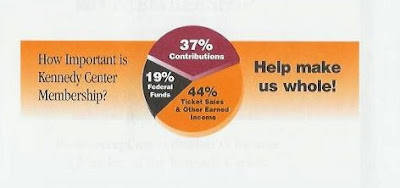 So where is the Membership? I guess it's "Contributions"? But if that is so, WHY MAKE ME THINK?
Why not just call it "Membership" so I can establish an immediate visual connection between the Question and the Answer?
But it's not over yet.
The pie-chart is followed by a call to action: "Help make us whole!"
Yes, BUT HOW? That's not clear either.
Here is the Other Cardinal Rule of direct mail envelope copy - If you are asking the reader to do something, you should also provide specific steps to complete the requested action.
From the pie, it's not clear which slice should I help EXPAND to make it the WHOLE?
Should I help the Kennedy Center become WHOLE by increasing their Federal Funds?
Should I help the Kennedy Center become WHOLE by increasing their Ticket Sales & Other Earned Income?
Or,
Should I help the Kennedy Center become WHOLE by increasing their Contributions?
I suspect the Center would like me do the third pie-chart alternative.
Then why don't they simply tell me "Send in your Contribution today!" ?
The lesson -- do not force your readers to solve puzzles. That will drop your response rate considerably.
2) IONA Senior Services
 Their motto, printed right on the envelope, reads:
"Experts on Aging"
Like in "we are experts in helping you get older"?
Probably what they meant was this: "Experts in Elder Care..."
What a difference the right and wrong copy can make.
But here is the Number One Commandment of all envelope copy: Thou Shalt Not Confuse and Obfuscate.
Here are two recent direct-mail envelopes that I found in my mailbox recently that raise more questions than they answer.
1) The Kennedy Center
The back of the solicitation envelope that the Center mailed has a beautiful multicolor pie chart as an answer to the question: "How Important Is Kennedy Center Membership?"
So you look at the pie-chart to understand how important the "membership" is and guess what? NONE of the pie slices is labeled "Membership".
- The 37% slice is labeled "Contributions"
- The 19% slice is labeled "Federal Funds"
- The 44% slice is labeled "Ticket Sales & Other Earned Income"
 So where is the Membership? I guess it's "Contributions"? But if that is so, WHY MAKE ME THINK?
Why not just call it "Membership" so I can establish an immediate visual connection between the Question and the Answer?
But it's not over yet.
The pie-chart is followed by a call to action: "Help make us whole!"
Yes, BUT HOW? That's not clear either.
Here is the Other Cardinal Rule of direct mail envelope copy - If you are asking the reader to do something, you should also provide specific steps to complete the requested action.
From the pie, it's not clear which slice should I help EXPAND to make it the WHOLE?
Should I help the Kennedy Center become WHOLE by increasing their Federal Funds?
Should I help the Kennedy Center become WHOLE by increasing their Ticket Sales & Other Earned Income?
Or,
Should I help the Kennedy Center become WHOLE by increasing their Contributions?
I suspect the Center would like me do the third pie-chart alternative.
Then why don't they simply tell me "Send in your Contribution today!" ?
The lesson -- do not force your readers to solve puzzles. That will drop your response rate considerably.
2) IONA Senior Services
 Their motto, printed right on the envelope, reads:
"Experts on Aging"
Like in "we are experts in helping you get older"?
Probably what they meant was this: "Experts in Elder Care..."
What a difference the right and wrong copy can make.
Wednesday, August 22, 2007
Windows IE’s Research Tool
My regular readers know how much I like open source software and operating systems.
I’ve just had the privilege of having a look at the Beta version of (Linux) Ubuntu’s latest 7.1 upgrade, for example, thanks to the way my wonderful son keeps on top of these things. And I must tell you – it’s even BETTER than Mac OS X! It’s just awesome as we’ll all have the chance to appreciate it for ourselves when it’s officially released in October. (And of course, it’ll be FREE as usual.)
But I digress… despite all that, I still think Windows Internet Explorer holds a special place among all browsers because there are still a lot of things that are optimized only for Windows IE.
Take the Google Pages, for example, Google’s free and versatile web page design and hosting functionality. I’ve been using Google Pages for over a year now to host and maintain my main site www.writer111.com and I have only a SINGLE complaint: a number of editing functions work only if you are using IE browser on a Windows platform.
Today I’d like to bring to your attention to another great tool that is available with IE – it’s great built-in research tool, hidden under the Research button (two books under a magnifying glass).
You click it and a sidebar opens on the left.
Type in your search word and then click the drop-down menu button in the next field.
Windows allows you to make a quick search from the following sources:
Encarta English dictionary, Encarta Thesaurus in 3 languages, Translation module, Encarta Encyclopedia, Factiva iWorks, HighBeam Research, MSN Search, MSN Money Stock quotes, and Thomson Gale Company Profiles.
If you are a writer or researcher such functionality comes in very handy indeed.
I’ve just had the privilege of having a look at the Beta version of (Linux) Ubuntu’s latest 7.1 upgrade, for example, thanks to the way my wonderful son keeps on top of these things. And I must tell you – it’s even BETTER than Mac OS X! It’s just awesome as we’ll all have the chance to appreciate it for ourselves when it’s officially released in October. (And of course, it’ll be FREE as usual.)
But I digress… despite all that, I still think Windows Internet Explorer holds a special place among all browsers because there are still a lot of things that are optimized only for Windows IE.
Take the Google Pages, for example, Google’s free and versatile web page design and hosting functionality. I’ve been using Google Pages for over a year now to host and maintain my main site www.writer111.com and I have only a SINGLE complaint: a number of editing functions work only if you are using IE browser on a Windows platform.
Today I’d like to bring to your attention to another great tool that is available with IE – it’s great built-in research tool, hidden under the Research button (two books under a magnifying glass).
You click it and a sidebar opens on the left.
Type in your search word and then click the drop-down menu button in the next field.
Windows allows you to make a quick search from the following sources:
Encarta English dictionary, Encarta Thesaurus in 3 languages, Translation module, Encarta Encyclopedia, Factiva iWorks, HighBeam Research, MSN Search, MSN Money Stock quotes, and Thomson Gale Company Profiles.
If you are a writer or researcher such functionality comes in very handy indeed.
Monday, August 20, 2007
How to Copy and Paste with OpenOffice on a Mac
I love OpenOffice because it’s a very powerful and FREE open source office application. Its lack of enterprise-level mail program (like Outlook) is its only shortcoming. Otherwise it’s (at least) as good as its Microsoft counterparts Word, Excel, PowerPoint and Access.
However you need to be careful if you have downloaded the Mac version of OpenOffice to your Macbook or any other Mac machine because Macs run OpenOffice through an outer shell program called X11. You first download X11 and then OpenOffice will work.
It works but not thew ay you are used to when it comes to Copying and Pasting text between OpenOffice and a non-OpenOffice application, like Safari or Firefox browser, for example.
Here is a must tip for copying and pasting text between your OpenOffice word processor and your email window. It’s a MUST because if you don’t know this you cannot copy and paste your text.
When you are in OpenOffice COPY by pressing CRTL+C.
But when it comes to PASTING it in your email window, use APPLE BUTTON + V.
No other combination will work since within the X11 shell, you can access your clipboard through the CTRL button only. However, when you are in the mail screen, you are no more in X11 but in Apple environment. Therefore you can reach the clipboard only through an Apple command, which is accomplished by switching to the APPLE BUTTON.
However you need to be careful if you have downloaded the Mac version of OpenOffice to your Macbook or any other Mac machine because Macs run OpenOffice through an outer shell program called X11. You first download X11 and then OpenOffice will work.
It works but not thew ay you are used to when it comes to Copying and Pasting text between OpenOffice and a non-OpenOffice application, like Safari or Firefox browser, for example.
Here is a must tip for copying and pasting text between your OpenOffice word processor and your email window. It’s a MUST because if you don’t know this you cannot copy and paste your text.
When you are in OpenOffice COPY by pressing CRTL+C.
But when it comes to PASTING it in your email window, use APPLE BUTTON + V.
No other combination will work since within the X11 shell, you can access your clipboard through the CTRL button only. However, when you are in the mail screen, you are no more in X11 but in Apple environment. Therefore you can reach the clipboard only through an Apple command, which is accomplished by switching to the APPLE BUTTON.
Wednesday, August 15, 2007
MS Excel -- How to join texts in different cells
Imagine you have the name of your company in cell A1 and the address in F1 but you would like to add the address to the company name and display them in a new cell, D1.
This is how you can do it:
Click and select cell D1.
Click the fx link to the left of the Formula Bar to display the Insert Function dialog box.
Select TEXT for category and then select the CONCATENATE function.
Click OK to display the Function Arguments dialog box for the CONCATENATE function.
In Text1 field insert the cell ID of the text “ABC Company” (which is A1 in this example).
In Text2 field, hit the SPACE BAR to introduce a space between two text fragments.
In Text3 field insert the cell ID of the text “123 Main Street” (which is F1 in this example).
Click OK and The Company name and Address will be now displayed in cell D1.
Obviously in as simple an example as this, you might as well just copy and paste the text from one cell to another too.
But imagine having 20 or 30 different pieces of text dispersed all over a spreadsheet. That’s when the concatenation function really comes in handy.
MS Excel can concatenate up to 30 text items, including the spaces.
This is how you can do it:
Click and select cell D1.
Click the fx link to the left of the Formula Bar to display the Insert Function dialog box.
Select TEXT for category and then select the CONCATENATE function.
Click OK to display the Function Arguments dialog box for the CONCATENATE function.
In Text1 field insert the cell ID of the text “ABC Company” (which is A1 in this example).
In Text2 field, hit the SPACE BAR to introduce a space between two text fragments.
In Text3 field insert the cell ID of the text “123 Main Street” (which is F1 in this example).
Click OK and The Company name and Address will be now displayed in cell D1.
Obviously in as simple an example as this, you might as well just copy and paste the text from one cell to another too.
But imagine having 20 or 30 different pieces of text dispersed all over a spreadsheet. That’s when the concatenation function really comes in handy.
MS Excel can concatenate up to 30 text items, including the spaces.
Wednesday, August 1, 2007
Two Giants in Two Days
 The world of motion pictures has lost two giants within the last two days -- Ingmar Bergman, and Michelangelo Antonioni.
 I must admit that I could never take a shine to Bergman. His films left me cold, drained, without a drop of sunshine.
So why did I love Antonioni that much? His classic trilogy (“L’Avventura” (1960), “La Notte” (1961) and “L’Eclisse” (1962)) was not exactly a display of "fun under the sun" either.
But first of all, Antonioni's courage to leave behind the 2,300 years old 3-Act paradigm and sail towards the unchartered waters of emotions-without-a-plot really fascinated me.
Secondly, the way he brought the sense of modern alienation into focus will probably be without an equal for a long time to come.
His "Blowup" was not bad either but at the level of the Trilogy. "The Passenger" with Jack Nicholson is another latter-day Antonioni classic that should be on every cinema fan's must-see list.
The Italian master will be missed. And perhaps I'll write about him more later on.
For the time being, I'll refer you to this excellent NYT review.
Tuesday, July 31, 2007
Google's Killer App
By Brandt Dainow
Google Analytics 2.0 changes everything, and according to the CEO of ThinkMetrics, the competition is dead. They just haven't stopped moving yet.
Death by Google
Google has killed the web analytics software industry with the release of the new version of Google Analytics. The new version was released just under two months ago and is simply a quantum leap above any other analytics product on the planet.
In my opinion, Google Analytics does for the web metrics industry what the Google search engine did for online search: it kills everyone else off.
Google Analytics version 2 is not revolutionary. It does not extend web analytics software by providing new forms of analysis. Neither does it extend our understanding of websites by offering new approaches. What Google has done is simply take every feature in every product on the market and put them all into one system, and then make it available for free.
http://www.imediaconnection.com/Newsletter/15823.asp
Google Analytics 2.0 changes everything, and according to the CEO of ThinkMetrics, the competition is dead. They just haven't stopped moving yet.
Death by Google
Google has killed the web analytics software industry with the release of the new version of Google Analytics. The new version was released just under two months ago and is simply a quantum leap above any other analytics product on the planet.
In my opinion, Google Analytics does for the web metrics industry what the Google search engine did for online search: it kills everyone else off.
Google Analytics version 2 is not revolutionary. It does not extend web analytics software by providing new forms of analysis. Neither does it extend our understanding of websites by offering new approaches. What Google has done is simply take every feature in every product on the market and put them all into one system, and then make it available for free.
http://www.imediaconnection.com/Newsletter/15823.asp
Monday, July 30, 2007
Screenwriting – The Power of “Character Arcs”
 A “character arc,” that is, the changes a character goes through during the 2 hours of a movie, is one of the most tricky aspects of screenwriting.
 You miss it, and you have in your hands a flat piece of narrative, a chain of events without a human-emotional core. Such movies do not move us to laughter or tears.
Nail it on the head, and the whole narrative comes alive like the juice hitting a light bulb. We can now identify with those characters and feel the satisfaction of living through their lives vicariously. Our hearts expand. Our souls take wings. Those are the movies we love to watch more than once.
LITTLE MISS SUNSHINE (2006) is one such jewel in which not one but all SIX characters go through clearly defined sharp character arcs. It is a good example of careful and loving writing by Michael Arndt which won the Best Original Screenplay Oscar for him this year. Alan Arkin, as grandpa Hoover, also won a well-deserved Best Supporting Actor Oscar with his unforgettable performance in “Sunshine.”
Here are the SIX arcs for SIX characters in “Sunshine”:
(WARNING: Plot points are revealed.)
OLIVE: A seven year old darling of a girl, a perfect picture of innocence, who is not quite sure of herself, whether she can win the contest and make her daddy proud… arcs to… an uninhibited beauty pageant performer on stage “kicking ass” with the dance routine taught her by her grandpa. Shy Olive refuses to be intimidated by her more polished competitors, brings down the house and shows her own dad what “winning” is all about.
RICHARD: A stuck-up and judgmental disciplinarian, a paint-by-numbers motivational speaker with strong Protestant-ethic work values, unsympathetic to the plight of the losers of the world… arcs to… himself becomes the kind of loser that he always despised in the past, gets rid of his self-righteous inhibitions and joins in with his daughter’s “ass kicking” stage performance.
DWAYNE: A catatonic and depressed teenager idolizing Frederick Nietzsche who would no talk to anyone and would communicate only by writing on a note pad… arcs to… a young adult who comes to full terms with his worst fear of not being able to become an air force pilot due to his color blindness, he starts talking with his family, and joins Olive on the stage for a wild “ass kicking” stage performance.
GRANDPA: A cantankerous foul-mouthed old man who had been kicked out of a nursing home for his heroin habit, who is bitterly critical of the world and in particular of his son’s attempts to lead a clean and “ideal” family life… arcs to… his granddaughter Olive’s most precious role model and talent coach, and a man who truly appreciates his son’s courage and the risks he is taking in life to prove himself.
SHERYL: A mother who is trying to hold her family together by acting as the sane moderator, a good woman who is busy putting out fires, steering the dysfunctional characters in her family towards common sense solutions, but also a homemaker who feels the full brunt of the family’s financial problems… arcs to… the only family member who refuses to blink at the brink of Olive’s critical talent show stage appearance, a mountain of inner strength who refuses to be intimidated by the prospects of failure even when her son and husband give in and want to pack it up and go back home.
FRANK: A catatonic survivor of a suicide attempt sitting in a wheelchair at a mental hospital before his sister Sheryl takes him to her home to join the rest of the family, a world-class Proust scholar driven to self-loathing and self-destruction for losing his male lover to his chief competitor in the academic world… arcs to… a man literally running ahead of anyone else to the hotel ballroom where Little Miss Sunshine competition is held to make sure Olive would not miss the registration, a lonely pessimist who becomes an unexpected mentor to the equally depressed Dwayne, accepts all his loses in life and joins the rest of the family on the stage to celebrate Olive’s improbable “kick ass” stage performance.
Six well developed non-overlapping characters. Six arcs. Six paths to a better life, or at least, a deeper life where love, solidarity and understanding replace hatred, sarcasm and anger.
What else can we expect from a movie?
If you are a screenwriter you owe it to yourself to watch this very well written Oscar winner and study and learn from it.
Sunday, July 29, 2007
Multitasking Tips
For all you work-from-home professionals, here are some multitasking tips from David Meyer, a professor of cognition and perception at the University of Michigan (brought to you by WIRED magazine):
1) Double up on tasks that use different mental channels like writing a report and brainstorming for a company logo.
2) Think carefully about the requirements of each task. If you are trying to close the sales while driving a car and the conversation does not go as planned you might be endangering both your life and the lives of innocent others.
3) Minimize unnecessary distractions by switching off your phone ringer, shutting down your email and closing the door (if you have one).
4) Interrupt tasks at natural breaking points. Finish writing a sentence before answering a phone.
5) Set aside time for not doing anything at all. Take breaks, eat well, exercise and make sure you get enough sleep.
1) Double up on tasks that use different mental channels like writing a report and brainstorming for a company logo.
2) Think carefully about the requirements of each task. If you are trying to close the sales while driving a car and the conversation does not go as planned you might be endangering both your life and the lives of innocent others.
3) Minimize unnecessary distractions by switching off your phone ringer, shutting down your email and closing the door (if you have one).
4) Interrupt tasks at natural breaking points. Finish writing a sentence before answering a phone.
5) Set aside time for not doing anything at all. Take breaks, eat well, exercise and make sure you get enough sleep.
Sunday, July 22, 2007
Hollywood Writers Up in Arms Over "Residuals"
In this day and age of free YouTube downloads, webisodes, and mobisodes, "creatives" of Hollywood think they are shortchanged. They want a piece of the "backend." They want "residuals." That is, they want to get paid everytime, for example, you log on to ABC's web site and watch any episode of any show.
Or else? WGA, The all-powerful Writers Guild of America, will go on strike on October 31. So the studios are busy like crazy stocking up on extra scripts and shooting all those back-logged episodes so they'll be ready if and when the writer's strike hits Hollywood like a tsunami.
"Tsunami"? Well, perhaps I went overboard with that description because the last time WGA went on strike in the 1980s over the home video rights, 9,000 WGA members walked out. But then they came back for only 0.3 cents on the dollar! It turned out the writers' pocketbooks bled a lot faster that the "suits" in corporate offices. It's an embarrassing episode that most WGA members would rather forget.
One alternative is for the suits and the creatives share the ad revenues on these sites. But probably that's not going to happen anytime soon since the suits accuse the writers with splitting the profits but not the risks as, for example, when a show that has cost tens of millions of dollars bombs completely.
Or else? WGA, The all-powerful Writers Guild of America, will go on strike on October 31. So the studios are busy like crazy stocking up on extra scripts and shooting all those back-logged episodes so they'll be ready if and when the writer's strike hits Hollywood like a tsunami.
"Tsunami"? Well, perhaps I went overboard with that description because the last time WGA went on strike in the 1980s over the home video rights, 9,000 WGA members walked out. But then they came back for only 0.3 cents on the dollar! It turned out the writers' pocketbooks bled a lot faster that the "suits" in corporate offices. It's an embarrassing episode that most WGA members would rather forget.
One alternative is for the suits and the creatives share the ad revenues on these sites. But probably that's not going to happen anytime soon since the suits accuse the writers with splitting the profits but not the risks as, for example, when a show that has cost tens of millions of dollars bombs completely.
Gobbledygook of the Day: "Swimming Venues"
Obfuscation, or making what is plain unclear and cover it with a veil of mystery, comes easy to some public speakers.
The other day as I was driving in my car and listening to a program on the various hazards of spending a day at the beach, I heard one of the experts say:
"I have to caution your listeners to be careful when they visit hundreds of thousands of swimming venues this summer..."
SWIMMING VENUES??? That was a new one for me. Why not just say "pools and beaches"?
Clarity and relevance should not be the cost of abstraction and generalization.
The other day as I was driving in my car and listening to a program on the various hazards of spending a day at the beach, I heard one of the experts say:
"I have to caution your listeners to be careful when they visit hundreds of thousands of swimming venues this summer..."
SWIMMING VENUES??? That was a new one for me. Why not just say "pools and beaches"?
Clarity and relevance should not be the cost of abstraction and generalization.
Saturday, July 21, 2007
Google Analytics - Simply Amazing!
If you haven't tried "Google Analytics" yet you owe it to yourself to check it out right away.
If you have a web site and if you'd like to see who is visiting your site, when, from where (including country and city), how much time they spend on what page, etc. then you need Google Analytics -- which is FREE.
You register with Google and place your custom-generated HTML code inside the HEAD section of all the pages you'd like to track. The rest is taken care of by Google.
All reports can be mailed in 4 different formats both to yourself and to anybody else you like on earth.
You can track the traffic of multiple web sites from one single account.
There are some truly very smart people working out there in Google. They continue to amaze me on a weekly basis.
While Microsoft is trying to protect its hold on the IT sector through all kinds of marketing strategies but weak products, Google is letting their products do the talking.
If you have a web site and if you'd like to see who is visiting your site, when, from where (including country and city), how much time they spend on what page, etc. then you need Google Analytics -- which is FREE.
You register with Google and place your custom-generated HTML code inside the HEAD section of all the pages you'd like to track. The rest is taken care of by Google.
All reports can be mailed in 4 different formats both to yourself and to anybody else you like on earth.
You can track the traffic of multiple web sites from one single account.
There are some truly very smart people working out there in Google. They continue to amaze me on a weekly basis.
While Microsoft is trying to protect its hold on the IT sector through all kinds of marketing strategies but weak products, Google is letting their products do the talking.
Friday, July 20, 2007
Copy + Paste is not a simple operation with MacBook
MacBook is a visually stunning gorgeous piece of hardware which makes its software issues all the more so heartbreaking. It's the equivalent of a very beautiful girl belching aloud in public.
I've previously written here about the kind of problems the Mac-native browser Safari has with some Google functionalities that I use on a regular bases (like Google Documents, and Google Pages).
Yesterday I was dismayed to discover yet another MacBook dysfunction, this one much more serious than the Google incompatibility issue.
It is hard to believe but...
If you copy text from your word document, MacBook will NOT allow you to paste it into either your e-mail message or any Google Document file!
The only way you can send that text is to save it as a separate file and then ATTACH it to your e-mail, or just type the whole thing the good-old fashioned way. (I hope, unlike me, you are fast typist.)
I still find that hard to believe... such a glaring shortcoming, and yet, MacBooks are still selling like hotcakes.
I'm praying I'm wrong and that I just missed a very simple setting that will eventually set everything right.
But I tried it both with Safari and Firefox and both don't work. If you copy from a file on your machine, you cannot paste it into your e-mail window.
I have no idea what to make of that but if I cannot fix it one way or the other, I think I am returning my beautiful MacBook back to the store and order myself the new DELL UBUNTU lap top. At least I know most of the things that can go wrong on an UBUNTU system and copy-paste function is not one of them.
POST SCRIPT:
After talking with Mac people, it became apparent that the copy-paste does not woth with OPEN OFFICE but it does with MS Word.
I've previously written here about the kind of problems the Mac-native browser Safari has with some Google functionalities that I use on a regular bases (like Google Documents, and Google Pages).
Yesterday I was dismayed to discover yet another MacBook dysfunction, this one much more serious than the Google incompatibility issue.
It is hard to believe but...
If you copy text from your word document, MacBook will NOT allow you to paste it into either your e-mail message or any Google Document file!
The only way you can send that text is to save it as a separate file and then ATTACH it to your e-mail, or just type the whole thing the good-old fashioned way. (I hope, unlike me, you are fast typist.)
I still find that hard to believe... such a glaring shortcoming, and yet, MacBooks are still selling like hotcakes.
I'm praying I'm wrong and that I just missed a very simple setting that will eventually set everything right.
But I tried it both with Safari and Firefox and both don't work. If you copy from a file on your machine, you cannot paste it into your e-mail window.
I have no idea what to make of that but if I cannot fix it one way or the other, I think I am returning my beautiful MacBook back to the store and order myself the new DELL UBUNTU lap top. At least I know most of the things that can go wrong on an UBUNTU system and copy-paste function is not one of them.
POST SCRIPT:
After talking with Mac people, it became apparent that the copy-paste does not woth with OPEN OFFICE but it does with MS Word.
Tuesday, July 17, 2007
MSN News versus Google News search functions
I find Google's news search functionality to be a lot more accurate and focused than MSN's news search.
Here is an unscientific comparison for a specific key phrase. You be the judge.
TOP 10 MSN News Search results for search key phrase “travel nurse”:
http://search.msn.com/news/results.aspx?q=travel+nurse&form=QBNR&go.x=13&go.y=6
TITLES of the returned articles:
TOP 10 Google News Search results for search key phrase “travel nurse”:
http://news.google.com/news?hl=en&ned=us&q=travel+nurse
TITLES of the returned articles:
Here is an unscientific comparison for a specific key phrase. You be the judge.
TOP 10 MSN News Search results for search key phrase “travel nurse”:
http://search.msn.com/news/results.aspx?q=travel+nurse&form=QBNR&go.x=13&go.y=6
TITLES of the returned articles:
She's always ready to go Retired nurse packs her bags at a moment's ...
For fliers, fares are still ascending
Summer nights: Rimini
You want screenwriting advice? Ask this writer
Couple creating a refuge for children
Free health screenings in Haines City
Make My Day
Letters: 'Our government needs a serious overhaul'
Transplant Rules to Let Children Stay Home
Missing, found, but in denial
TOP 10 Google News Search results for search key phrase “travel nurse”:
http://news.google.com/news?hl=en&ned=us&q=travel+nurse
TITLES of the returned articles:
Pack up your troubles
ATC Healthcare Revenue Increases 25% for the First Quarter of ...
Jury consultant in nurse murder trial tells lawyers how to dress ...
She's always ready to go Retired nurse packs her bags at a ...
Take Care will contract with individual doctors to oversee nurse practitioners who staff
New Study of Nurses Reveal Sources of Injectable Medication Errors
“Surgery Robots” Mean More Education and Training for both Nurses ...
Hanover works to recruit nurses
Thanks for the miracle
Traveling man
Copy That Creates Questions
Good copy should answer questions, not create them.
From an air filter commercial:
Really?
If a product is NINE times better than the "leading brand," how come it trails behind? How come it's not the leading brand?
Either the consumers don't know what they're doing, or the copywriter...
Troubling questions that did not exist before the commercial.
From an air filter commercial:
"Nine times better than the leading brand..."
Really?
If a product is NINE times better than the "leading brand," how come it trails behind? How come it's not the leading brand?
Either the consumers don't know what they're doing, or the copywriter...
Troubling questions that did not exist before the commercial.
Monday, July 16, 2007
Firefox Works on Mac OS 10 Tiger, well, "sort of"
Firefox browser works better than Mac-native Safari as far as some Google functions are concerned.
For example, one can reach all Blogger controls when posting onto a blog from inside Firefox.
However, Google Page Creator still does not work. The Fox cannot catch Fire on that one item, unfortunately.
If you are planning to edit your Google Page Creator web site you need to use IE browser on a Windows machine.
Is this Google's problem? The problem of Mozilla/Firefox or Apple/OS X team? Or all of them?
It seems like someone does not like us to use Google Page Creator on any platform other than IE/Windows.
That's unfortunate because I really love the simplicity and versatility of Google Pages and have my official site built with it (www.writer111.com). It really works for me except I need to switch to my IE/Windows machine every time I need to edit it.
I'm lucky and I have access to a Windows machine as well. But what about those who are operating only on Linux or Mac systems?
For example, one can reach all Blogger controls when posting onto a blog from inside Firefox.
However, Google Page Creator still does not work. The Fox cannot catch Fire on that one item, unfortunately.
If you are planning to edit your Google Page Creator web site you need to use IE browser on a Windows machine.
Is this Google's problem? The problem of Mozilla/Firefox or Apple/OS X team? Or all of them?
It seems like someone does not like us to use Google Page Creator on any platform other than IE/Windows.
That's unfortunate because I really love the simplicity and versatility of Google Pages and have my official site built with it (www.writer111.com). It really works for me except I need to switch to my IE/Windows machine every time I need to edit it.
I'm lucky and I have access to a Windows machine as well. But what about those who are operating only on Linux or Mac systems?
The Gobbledygook Word of The Year: “Specificity”
Perhaps it’s still too early for the nominations but I hereby nominate the following monstrosity for the Gobbledygook Word of The Year:
“Specificity”, and even worse, “Specificities”, in its plural form.
Try saying it three times in a row and you’ll instantly forget what time it is or where you are.
Examples from world press:
“Specificity” has two main definitions. Its medical definition means something.
But its non-medical definition is a true abomination. It describes anything but a state of being “specific.” It’s just a vacuous place holder for an idea not quite formed in an ill-informed mind.
MEDICAL definition: “The ability of a test to detect that a condition is not present when it is, in fact, not present. The proportion of people free of a disease who have a negative test.”
NON-MEDICAL definition: “The quality of being specific rather than general; "add a desirable note of specificity to the discussion"; "the specificity of the symptoms of the disease.””
To refer to a group of items that are not clearly defined as “specificities” is as ridiculous an act as calling a group of dead people “existentiaries”.
There should be an article in the penal code against using such words of obfuscation that pollute public communication channels and thus undermine common good, peace and harmony.
“Specificity”, and even worse, “Specificities”, in its plural form.
Try saying it three times in a row and you’ll instantly forget what time it is or where you are.
Examples from world press:
“Angola: SADC Secretary Acknowledges Country's Specificities” (Angola Press Agency)
"This White Paper … enhances the visibility of sport in EU policy-making, raises awareness of the needs and specificities of the sport sector, and identifies appropriate further action at EU level." (Ján Figel, European Commissioner in charge of Education, Training, Culture & Youth, including Sport)
The European Neighbourhood Policy (ENP) Action Plans, which were signed in November 2006, take into account the specificities of the South Caucasus countries.” (Ambassador Per Eklund, Head of Delegation of the European Commission to Georgia and Armenia)
“Specificity” has two main definitions. Its medical definition means something.
But its non-medical definition is a true abomination. It describes anything but a state of being “specific.” It’s just a vacuous place holder for an idea not quite formed in an ill-informed mind.
MEDICAL definition: “The ability of a test to detect that a condition is not present when it is, in fact, not present. The proportion of people free of a disease who have a negative test.”
NON-MEDICAL definition: “The quality of being specific rather than general; "add a desirable note of specificity to the discussion"; "the specificity of the symptoms of the disease.””
To refer to a group of items that are not clearly defined as “specificities” is as ridiculous an act as calling a group of dead people “existentiaries”.
There should be an article in the penal code against using such words of obfuscation that pollute public communication channels and thus undermine common good, peace and harmony.
What you definitely do NOT need to WRITE a good screenplay?
You definitely, absolutely, positively do NOT need any of the following to START and FINISH writing a good screenplay:
An encyclopedic knowledge of every movie ever written.
Watching ten movies a week.
An intimate knowledgeable of the “lingo” used in Hollywood shoptalk.
Subscriptions to all Hollywood related magazine and newsletters.
Spending thousands of dollars on famous screenwriting workshops.
A Hollywood agent, manager and/or publicist.
An intimate knowledgeable of the way Los Angeles and Hollywood works.
An English, Film Studies or Screenwriting degree from a well-known college.
A college degree of any kind, including a Master’s or a P-h-D.
An intimate knowledgeable of Shakespeare.
Any drug habit.
Smoking cigarettes and/or drinking alcohol.
To be a Christian, Moslem, Jew, Hindu, Scientologist, Atheist or to belong (or not to belong) to any other religion or belief system.
An intimate knowledgeable of the underworld and the seedy side of life.
An intimate knowledgeable of police and court procedurals.
An intimate knowledgeable of doctors and hospitals.
Lots of cash in the bank.
To be homeless and at the edge of absolute poverty.
Lots of free idle time.
An “Oscar material” subject matter.
An idea that has never been written before.
A film that A-List Hollywood actors would die to star in.
To be under 25 or 30.
To be over 40 or 50.
To be any given specific age.
To be a male or female.
To be straight, gay, or of any other sexual orientation.
To be white, black, Hispanic, Indian, Oriental or belong to any of the thousands of ethnic/racial groups.
To have a child or not to have a child.
To come from a large or a small family.
To have been born in the United States or abroad.
A top-notch professional screen writing software.
A Mac brand or any other brand computer.
A blog and/or web site visited by thousands of people a day.
A house in any neighborhood of any city on earth.
The latest cell phone or Blackberry with all the bells and whistles.
A great looking sports car or any given brand of vehicle.
Visiting Europe for your vacations or any other country or spot on earth for any occasion.
An encyclopedic knowledge of every movie ever written.
Watching ten movies a week.
An intimate knowledgeable of the “lingo” used in Hollywood shoptalk.
Subscriptions to all Hollywood related magazine and newsletters.
Spending thousands of dollars on famous screenwriting workshops.
A Hollywood agent, manager and/or publicist.
An intimate knowledgeable of the way Los Angeles and Hollywood works.
An English, Film Studies or Screenwriting degree from a well-known college.
A college degree of any kind, including a Master’s or a P-h-D.
An intimate knowledgeable of Shakespeare.
Any drug habit.
Smoking cigarettes and/or drinking alcohol.
To be a Christian, Moslem, Jew, Hindu, Scientologist, Atheist or to belong (or not to belong) to any other religion or belief system.
An intimate knowledgeable of the underworld and the seedy side of life.
An intimate knowledgeable of police and court procedurals.
An intimate knowledgeable of doctors and hospitals.
Lots of cash in the bank.
To be homeless and at the edge of absolute poverty.
Lots of free idle time.
An “Oscar material” subject matter.
An idea that has never been written before.
A film that A-List Hollywood actors would die to star in.
To be under 25 or 30.
To be over 40 or 50.
To be any given specific age.
To be a male or female.
To be straight, gay, or of any other sexual orientation.
To be white, black, Hispanic, Indian, Oriental or belong to any of the thousands of ethnic/racial groups.
To have a child or not to have a child.
To come from a large or a small family.
To have been born in the United States or abroad.
A top-notch professional screen writing software.
A Mac brand or any other brand computer.
A blog and/or web site visited by thousands of people a day.
A house in any neighborhood of any city on earth.
The latest cell phone or Blackberry with all the bells and whistles.
A great looking sports car or any given brand of vehicle.
Visiting Europe for your vacations or any other country or spot on earth for any occasion.
Safari - A Handsome Browser with Google Limitations
Mac's SAFARI browser is a great, sleek browsing machine until you want it to accomplish some specific Google-related chores that you could do easily with Firefox and IE.
One great disappointment, for example, is the way Safari cannot display most of the Google Blogger posting controls. You cannot bold or italic your text, cannot spellcheck, etc.
Also, if you are using Google's great online web builder and free hosting service "Google Pages," Safari does not work AT ALL. Period. Google is aware of the pesky issue and a message page recommends the user to download Firefox. Thanks, really.
But I have to note that, if you are using Firefox on a Linux distribution like Ubuntu, the editing function of Google Pages still does not work. You still need IE on a Windows machine to edit your Google Pages. Consumer beware!
What excuse Apple has to let Safari lag so many steps behind in functionality compared to Firefox and IE? For a company that markets itself as "on the cutting edge," it is unbecoming to rely on a browser that is not totally Google-compatible.
Great looks are great but we need full Google compatibility as well.
One great disappointment, for example, is the way Safari cannot display most of the Google Blogger posting controls. You cannot bold or italic your text, cannot spellcheck, etc.
Also, if you are using Google's great online web builder and free hosting service "Google Pages," Safari does not work AT ALL. Period. Google is aware of the pesky issue and a message page recommends the user to download Firefox. Thanks, really.
But I have to note that, if you are using Firefox on a Linux distribution like Ubuntu, the editing function of Google Pages still does not work. You still need IE on a Windows machine to edit your Google Pages. Consumer beware!
What excuse Apple has to let Safari lag so many steps behind in functionality compared to Firefox and IE? For a company that markets itself as "on the cutting edge," it is unbecoming to rely on a browser that is not totally Google-compatible.
Great looks are great but we need full Google compatibility as well.
10th Year - Happy Blogging!
I did not realize this is the 10th anniversary of the invention of blog.
Wall Street Journal observed the moment with a great piece: Happy Blogiversary.
"The spell check on Microsoft Word has yet to awaken to the concept of the blog. Type in "blogging," for instance, and you will promptly earn a disapproving underscore in red, with the suggestion that "bogging," "clogging," "flogging" or "slogging" (unappetizing alternatives all) might, in truth, be the word you seek."
Here are some famous folks and the blogs they read:
Harold Evans
Editor at large, the Week
Former editor, the Times of London
Favorite blogs: AndrewSullivan.com (political pundit for the Atlantic Monthly); MichaelTotten.com (Mideast affairs blogger); HeadButler.com (news and culture roundup)
Mia Farrow
The Editor in Chief: Me
Actress
Favorite blogs: BoingBoing.net (Tracks nooks and crannies of the Web); GPSMagazine.com (Everything about global positioning systems)
Brig. Gen. Kevin Bergner
'Milblogging' the War
Spokesman for Multi-National Force, in Iraq
Favorite blogs: "Around here, folks like to read Small Wars Journal (http://smallwarsjournal.com/index.php), Blackfive (http://www.blackfive.net/) and The Mudville Gazette (http://www.mudvillegazette.com/)."
Newt Gingrich
Former House speaker
Favorite blogs: RedState.com (Republican news and notes); Corner.NationalReview.com (conservative magazine's politics blog); PowerlineBlog.com (covers law and right-leaning politics)
Jim Buckmaster
CEO, Craigslist
Favorite blogs: Slashdot.org (one of the first tech blogs); Metafilter.com (community blog anyone can edit); Valleywag.com (tech gossip site); TechDirt.com (popular tech news site)
Wall Street Journal observed the moment with a great piece: Happy Blogiversary.
"The spell check on Microsoft Word has yet to awaken to the concept of the blog. Type in "blogging," for instance, and you will promptly earn a disapproving underscore in red, with the suggestion that "bogging," "clogging," "flogging" or "slogging" (unappetizing alternatives all) might, in truth, be the word you seek."
Here are some famous folks and the blogs they read:
Harold Evans
Editor at large, the Week
Former editor, the Times of London
Favorite blogs: AndrewSullivan.com (political pundit for the Atlantic Monthly); MichaelTotten.com (Mideast affairs blogger); HeadButler.com (news and culture roundup)
Mia Farrow
The Editor in Chief: Me
Actress
Favorite blogs: BoingBoing.net (Tracks nooks and crannies of the Web); GPSMagazine.com (Everything about global positioning systems)
Brig. Gen. Kevin Bergner
'Milblogging' the War
Spokesman for Multi-National Force, in Iraq
Favorite blogs: "Around here, folks like to read Small Wars Journal (http://smallwarsjournal.com/index.php), Blackfive (http://www.blackfive.net/) and The Mudville Gazette (http://www.mudvillegazette.com/)."
Newt Gingrich
Former House speaker
Favorite blogs: RedState.com (Republican news and notes); Corner.NationalReview.com (conservative magazine's politics blog); PowerlineBlog.com (covers law and right-leaning politics)
Jim Buckmaster
CEO, Craigslist
Favorite blogs: Slashdot.org (one of the first tech blogs); Metafilter.com (community blog anyone can edit); Valleywag.com (tech gossip site); TechDirt.com (popular tech news site)
Friday, July 13, 2007
Avoid Stuffy English
Commercial prose is so open to dragging in the deadwood to the center of your living room and just forgetting it there...
One such oddity I've heard this morning on the radio was the phrase "near impossibility."
People (in America) don't talk like that. They say something is "almost impossible" -- not "it is a near impossibility."
Even worse -- have you ever heard anybody saying "honey, don't forget to take your umbrella against a precipitation activity" (which might very well be a "near possibility"!).
Listen to any weather report and you can perhaps hear them issue an alert against "precipitation activity."
Sometimes even the traffic reporters get in the mood and start talking about an "accident activity on the right shoulder on I-95"... ugh!
Read aloud what you write and ask yourself if normal people talk like that. If they do, you've got great prose. Congratulations. If not, burn what you've written and don't tell anyone about it. We'll all be better for it.
One such oddity I've heard this morning on the radio was the phrase "near impossibility."
People (in America) don't talk like that. They say something is "almost impossible" -- not "it is a near impossibility."
Even worse -- have you ever heard anybody saying "honey, don't forget to take your umbrella against a precipitation activity" (which might very well be a "near possibility"!).
Listen to any weather report and you can perhaps hear them issue an alert against "precipitation activity."
Sometimes even the traffic reporters get in the mood and start talking about an "accident activity on the right shoulder on I-95"... ugh!
Read aloud what you write and ask yourself if normal people talk like that. If they do, you've got great prose. Congratulations. If not, burn what you've written and don't tell anyone about it. We'll all be better for it.
Shuttle's Name Misspelled On NASA Launch Pad Sign
(What an incredible story!)
local6.com
Shuttle's Name Misspelled On NASA Launch Pad Sign
Someone Called Kennedy Space Center NASA To Fix Typo
POSTED: 7:38 am EDT July 13, 2007
UPDATED: 9:25 am EDT July 13, 2007
The first NASA sign at launch pad 39A encouraging the next launch of space shuttle Endeavour at Kennedy Space Center was misspelled and noticed by someone looking at the craft.
When the shuttle rolled out from the Vehicle Assembly Building Wednesday, a giant "Go Endeavour" sign was put on a fence in front of the craft.
However, one item was missing from the sign: the "u" in Endeavour.
Someone spotted the mistake and called KSC to fix it, WKMG-TV reported.
NASA scrambled someone out to pad 39A with a new sign that has orbiter Endeavour's name spelled correctly.
A photo with the correct spelling was also posted on the Kennedy Space Center's Web site.
The orbiter is named after HM Bark Endeavour, the ship commanded by 18th century explorer James Cook; the name also honored Endeavour, the Command Module of Apollo 15. This is why the name is spelled in the British English manner, according to Answers.com.
Watch Local 6 News for more on this story.
local6.com
Shuttle's Name Misspelled On NASA Launch Pad Sign
Someone Called Kennedy Space Center NASA To Fix Typo
POSTED: 7:38 am EDT July 13, 2007
UPDATED: 9:25 am EDT July 13, 2007
The first NASA sign at launch pad 39A encouraging the next launch of space shuttle Endeavour at Kennedy Space Center was misspelled and noticed by someone looking at the craft.
When the shuttle rolled out from the Vehicle Assembly Building Wednesday, a giant "Go Endeavour" sign was put on a fence in front of the craft.
However, one item was missing from the sign: the "u" in Endeavour.
Someone spotted the mistake and called KSC to fix it, WKMG-TV reported.
NASA scrambled someone out to pad 39A with a new sign that has orbiter Endeavour's name spelled correctly.
A photo with the correct spelling was also posted on the Kennedy Space Center's Web site.
The orbiter is named after HM Bark Endeavour, the ship commanded by 18th century explorer James Cook; the name also honored Endeavour, the Command Module of Apollo 15. This is why the name is spelled in the British English manner, according to Answers.com.
Watch Local 6 News for more on this story.
Thursday, July 12, 2007
Importance of Keeping Your Work Close to Your Vest
It happens all the time...
A writer working on his or her first script, first novel, thinks it would a "great" idea to "share" it with a spouse, lover, child, friend, parent, co-worker or neighbor...
And the result is an unintended punch to the gut. The work stops right there. Enthusiasm and joy is replaced by doubts, second thoughts and eventually depression.
Why? Do our loved ones mean to harm us? Of course not.
Do they have an "ulterior motive" or a "sinister agenda"? Absolutely not.
But this is their problem -- they are NOT writers.
So they have no idea about the sensitive "mental and spiritual soup" in which our ideas and most precious creations ferment, multiply, and take shape as stories, scripts, articles and novels. It is a mysterious process, part "science" but mostly magic. That soup can be soured very easily by criticism while we are still adding crucial ingredients to it.
A lot of people think to give a "feedback" is to point out to the things that are missing. We all have that impulse to come across as "thoughtful" and usually the way we try to come across as thoughtful is to point out at what's "missing" or "wrong" with a project.
Even a casual and well-meaning comment like "I think that's been done before" is usually enough to dampen the spirits of a writer and mortgage her determination to press onward.
That's why I strongly recommend all my writer brothers and sisters not to show their hands too early, and not to ask their loved ones to read their stuff until it is 100% DONE. Only then they can read it if they please and enrich our work with their thoughful insights and learned suggestions.
But until then you have to protect your work just like a mother hen protects her chickens or a banker protects his vault.
A writer working on his or her first script, first novel, thinks it would a "great" idea to "share" it with a spouse, lover, child, friend, parent, co-worker or neighbor...
And the result is an unintended punch to the gut. The work stops right there. Enthusiasm and joy is replaced by doubts, second thoughts and eventually depression.
Why? Do our loved ones mean to harm us? Of course not.
Do they have an "ulterior motive" or a "sinister agenda"? Absolutely not.
But this is their problem -- they are NOT writers.
So they have no idea about the sensitive "mental and spiritual soup" in which our ideas and most precious creations ferment, multiply, and take shape as stories, scripts, articles and novels. It is a mysterious process, part "science" but mostly magic. That soup can be soured very easily by criticism while we are still adding crucial ingredients to it.
A lot of people think to give a "feedback" is to point out to the things that are missing. We all have that impulse to come across as "thoughtful" and usually the way we try to come across as thoughtful is to point out at what's "missing" or "wrong" with a project.
Even a casual and well-meaning comment like "I think that's been done before" is usually enough to dampen the spirits of a writer and mortgage her determination to press onward.
That's why I strongly recommend all my writer brothers and sisters not to show their hands too early, and not to ask their loved ones to read their stuff until it is 100% DONE. Only then they can read it if they please and enrich our work with their thoughful insights and learned suggestions.
But until then you have to protect your work just like a mother hen protects her chickens or a banker protects his vault.
Wednesday, July 11, 2007
Value of a Web Site ~ "Page Views" or "Time Spent"?
Nielsen rating company has shifted from the traditional “number of page views” to “time spent viewing a page” to measure a web site’s commercial worth.
This is a decision that will have a serious impact on all advertising companies that determine their web advertisement rates on the basis of such "objective" metrics.
The new Ajax technology seems to be the main culprit why Nielsen felt the need to adopt this new criterion. Ajax allows refreshing the web content without refreshing the page view. You must have noticed the way a new mail appears in your email window without re-loading the page, as we all used to do in the past.
Another reason why the traditional “page view” is considered losing its relevance is the streaming video sites like YouTube where visitors spend a lot of time on a single page watching one video clip after another.
On the basis of this new measuring stick, Nielsen has announced AOL as the winner of May’s “most popular” web site, with a total viewing time of 25 billion minutes, followed by Yahoo at 20 billion minutes. But by page view alone, AOL would have ranked sixth.
Google, although ranks 3rd by page views, dropped to fifth in terms of time spent since people leave Google screen quickly after a search is completed.
But I believe this new criterion has a serious flaw in this day and age of tabbed browsers.
What if you visit a site on one tab, then open another tab and go to another site, then do it for a third or fourth time? I find myself doing precisely that all the time.
What happens to the site left open for 20 hours on a forgotten tab? Does that mean that I have spent 20 hours on that site? Of course not.
How come Nielsen missed such a simple point is beyond me. I’m sure major advertisers are already grappling with this real issue.
This is a decision that will have a serious impact on all advertising companies that determine their web advertisement rates on the basis of such "objective" metrics.
The new Ajax technology seems to be the main culprit why Nielsen felt the need to adopt this new criterion. Ajax allows refreshing the web content without refreshing the page view. You must have noticed the way a new mail appears in your email window without re-loading the page, as we all used to do in the past.
Another reason why the traditional “page view” is considered losing its relevance is the streaming video sites like YouTube where visitors spend a lot of time on a single page watching one video clip after another.
On the basis of this new measuring stick, Nielsen has announced AOL as the winner of May’s “most popular” web site, with a total viewing time of 25 billion minutes, followed by Yahoo at 20 billion minutes. But by page view alone, AOL would have ranked sixth.
Google, although ranks 3rd by page views, dropped to fifth in terms of time spent since people leave Google screen quickly after a search is completed.
But I believe this new criterion has a serious flaw in this day and age of tabbed browsers.
What if you visit a site on one tab, then open another tab and go to another site, then do it for a third or fourth time? I find myself doing precisely that all the time.
What happens to the site left open for 20 hours on a forgotten tab? Does that mean that I have spent 20 hours on that site? Of course not.
How come Nielsen missed such a simple point is beyond me. I’m sure major advertisers are already grappling with this real issue.
Tuesday, July 10, 2007
Ambiguous Envelope Teaser
Envelope teasers are very crucial in direct mail since the prospective customer has about 3 or 5 seconds to decide whether to open your envelope or chuck it into the trash bin.
Here is a weak and rather annoying envelope teaser that would've directly gone to the trash basket if I weren't a professional copywriter who likes to meditate on these things and tries to learn something new everyday about this fascinating business of direct mail:
"Is This Little-Known Energy Company America's Next Major Uranium Producer?"
My first reaction is:
"You are asking ME? How the heck would I know? YOU are supposed to be the expert and yet you don't know whether THIS [whatever it is] little-known company is the next big thing on the horizon or not?"
As I read the envelope teaser I'm wondering if THIS is a way for me to make money OR provide free information to someone who doesn't quite has the skinny on this "little known company" yet...
Who knows, perhaps this "little known company" is little known for a very good reason indeed!
This teaser has already lost me with its indecisiveness.
Then comes the next line:
"Time-Sensitive Report. Open Immediately."
No. Sorry. I won't. Because who ever wrote the copy is not sure of this company at all. If the publisher is not sure of his/her facts, how can I trust him/her to lead me?
Why didn't this teaser really teased the heck out of me and did its job with no holds barred by saying something like:
"Little known company... about to explode (guaranteed!) as America's next major uranium producer. Limited-time opportunity to get in on the action before the little known company is not so anymore..."
Now, THAT would have perked my attention because of the firmness of the voice and the strength of the promise.
If you want me to open that envelope DO NOT ASK ME PUZZLES and DO NOT MAKE ME THINK.
If you are trying to write a teaser don't be halfhearted or shy about it. Make sure you are really TEASING instead of posing intellectual puzzles with no answers.
Here is a weak and rather annoying envelope teaser that would've directly gone to the trash basket if I weren't a professional copywriter who likes to meditate on these things and tries to learn something new everyday about this fascinating business of direct mail:
"Is This Little-Known Energy Company America's Next Major Uranium Producer?"
My first reaction is:
"You are asking ME? How the heck would I know? YOU are supposed to be the expert and yet you don't know whether THIS [whatever it is] little-known company is the next big thing on the horizon or not?"
As I read the envelope teaser I'm wondering if THIS is a way for me to make money OR provide free information to someone who doesn't quite has the skinny on this "little known company" yet...
Who knows, perhaps this "little known company" is little known for a very good reason indeed!
This teaser has already lost me with its indecisiveness.
Then comes the next line:
"Time-Sensitive Report. Open Immediately."
No. Sorry. I won't. Because who ever wrote the copy is not sure of this company at all. If the publisher is not sure of his/her facts, how can I trust him/her to lead me?
Why didn't this teaser really teased the heck out of me and did its job with no holds barred by saying something like:
"Little known company... about to explode (guaranteed!) as America's next major uranium producer. Limited-time opportunity to get in on the action before the little known company is not so anymore..."
Now, THAT would have perked my attention because of the firmness of the voice and the strength of the promise.
If you want me to open that envelope DO NOT ASK ME PUZZLES and DO NOT MAKE ME THINK.
If you are trying to write a teaser don't be halfhearted or shy about it. Make sure you are really TEASING instead of posing intellectual puzzles with no answers.
Sunday, July 8, 2007
No Copy is Better Than Lazy Copy
I have received this auto insurance offer by mail from a very well known wholesale merchandise company that reads:
"Save up to 20%..."
"As a XXXXX Member, you are now eligible for Money-Saving Auto Insurance RATES OF UP TO 20% OFF..."
My heart sank. Because XXXXX is a good company and they usually know what they are doing.
So how come they approved this lazy piece of copy that will not work for most of their prospective customers?
20% off OF WHAT for God's sake?
What is the base line here? What is our frame of reference?
How can the XXXXX officials know they are saving me "up to" 20% if they have no idea what my CURRENT rate is?
How do they know that their rate is not actually 20% MORE than what I have now?
What they are REALLY saying is "call us now and we will talk about it."
No sir, I will not call you now or later because your copy does not make sense and it also insults my intelligence. And if I were you I would hire a new copywriter right away.
If, however, they did quote a real person with real savings, then, who knows, I might've given them a shot.
A much better copy that read something like...
Then I might very well have given them a call. But not like this.
When consumers are treated like idiots they recoil. The only ones who won't will probably be the ones in desperate credit or financial problem. But are those the kind of customers that big corporations are trying to attract? I don't think so.
Good customers deserve good copy.
That's why I think "no copy" is much better than lazy and unintelligent copy.
Why?
Because when you do not send out any tired old mail pieces like this, you at least do not create question marks about the quality of the decisions made within your company. Your profits might remain level but your reputation and brand image would be intact.
"Save up to 20%..."
"As a XXXXX Member, you are now eligible for Money-Saving Auto Insurance RATES OF UP TO 20% OFF..."
My heart sank. Because XXXXX is a good company and they usually know what they are doing.
So how come they approved this lazy piece of copy that will not work for most of their prospective customers?
20% off OF WHAT for God's sake?
What is the base line here? What is our frame of reference?
How can the XXXXX officials know they are saving me "up to" 20% if they have no idea what my CURRENT rate is?
How do they know that their rate is not actually 20% MORE than what I have now?
What they are REALLY saying is "call us now and we will talk about it."
No sir, I will not call you now or later because your copy does not make sense and it also insults my intelligence. And if I were you I would hire a new copywriter right away.
If, however, they did quote a real person with real savings, then, who knows, I might've given them a shot.
A much better copy that read something like...
"THEY SAVED...
Our Member No. 123456 John Smith has saved 19.7% from his car insurance. And so did Jane Doe -- she couldn't believe it when we proved to her that she could save 18.5% over her existing rate.
How about YOU?
Wouldn't you like to find it out with a single toll-free phone call?"
Then I might very well have given them a call. But not like this.
When consumers are treated like idiots they recoil. The only ones who won't will probably be the ones in desperate credit or financial problem. But are those the kind of customers that big corporations are trying to attract? I don't think so.
Good customers deserve good copy.
That's why I think "no copy" is much better than lazy and unintelligent copy.
Why?
Because when you do not send out any tired old mail pieces like this, you at least do not create question marks about the quality of the decisions made within your company. Your profits might remain level but your reputation and brand image would be intact.
Saturday, July 7, 2007
5 Principles of "Freakonomics"
 I'm reading a book so provocative and amazing that it is challenging many of the "self evident" truths that I've held for quite some time now.
For example, did you ever consider that the late-90s precipitous drop in crime rates in large American cities, including NYC, could very well be a delayed effect of Roe vs. Wade decision? WOW!
Steven Levitt (Univ of Chicago and MIT) is obviously not your typical economist since he asks questions like "what are the similarities between the way sumo wrestlers and school teachers act?"
Here are the 5 tenets on which "Freakonomics" rests:
1) Incentives are the cornerstone of modern life.
2) The conventional wisdom is often wrong.
3) Dramatic effects often have distant, even subtle, causes.
4) "Experts" -- from criminologists to real-estate agents -- use their informational advantage to serve their own agenda.
5) Knowing what to measure and how to measure it makes a complicated world much less so.
When we write and design information, isn't that what we all are trying to achieve -- to make a complicated world less so?
Even in sales, you won't sell anything unless you can reduce a list of complicated features into a few solid benefits, correct?
I recommend this book to all my readers who would like to understand not how the modern world SHOULD work, but how it really DOES.
If you like a "tuneup from the neckup" (as Zig Ziglar used to say) you'll enjoy this gem of a book.
The Official Freakonomics Blog
New York Times Magazine Freakonomics Column
Wednesday, July 4, 2007
Missing Fourth Element in Basic Screenwriting Paradigm
You must have read the following "Basic Screenwriting Paradigm" a few times too many:
1) Get the cat on a tree.
2) Get the cat in trouble.
3) Get the cat down the tree.
This is of course very true. That's your basic bare-bones Aristotelean "3-Act Structure." It has not changed for the last 2,300 years or so.
However, it is not complete.
You also need a Fourth Element: the emotional reaction of your protagonist to the Step #3.
Without that fourth element, a "dramatic" movie rapidly devolves into a video tutorial of how to rescue a cat from a tree.
Don't get me wrong: video tutorials are great. They are fantastic tools of information design. But they are not dramatic stories for which the movie audience spends hard-earned cash.
As a creator, you have to be very clear on whether your are a documentary or a dramatic writer.
So here is the corrected basic paradigm:
1) Get the cat on a tree.
2) Get the cat in trouble.
3) Get the cat down the tree.
4) Get the hero react to the cat's rescue.
Or, for even a deeper dramatic twist:
1) Get the cat on a tree.
2) Get the cat in trouble.
3) Show the cat either getting down or not getting down the tree.
4) Get the hero react to the previous step.
1) Get the cat on a tree.
2) Get the cat in trouble.
3) Get the cat down the tree.
This is of course very true. That's your basic bare-bones Aristotelean "3-Act Structure." It has not changed for the last 2,300 years or so.
However, it is not complete.
You also need a Fourth Element: the emotional reaction of your protagonist to the Step #3.
Without that fourth element, a "dramatic" movie rapidly devolves into a video tutorial of how to rescue a cat from a tree.
Don't get me wrong: video tutorials are great. They are fantastic tools of information design. But they are not dramatic stories for which the movie audience spends hard-earned cash.
As a creator, you have to be very clear on whether your are a documentary or a dramatic writer.
So here is the corrected basic paradigm:
1) Get the cat on a tree.
2) Get the cat in trouble.
3) Get the cat down the tree.
4) Get the hero react to the cat's rescue.
Or, for even a deeper dramatic twist:
1) Get the cat on a tree.
2) Get the cat in trouble.
3) Show the cat either getting down or not getting down the tree.
4) Get the hero react to the previous step.
Happy 4th and an E-Card Utility for All Occasions
Happy 4th of July to all my American readers!

Here is an article by Peggy Noonan, one of my most favorite writers, that expresses the sentiments of the day very well:
http://www.opinionjournal.com/columnists/pnoonan/?id=110010269
In case you're wondering where I got the image from, here is my source (thanks to my client and reader Steve G.) :
Click here for iCards
It is a great utility to send quick, tasteful, and free postcards through e-mail.
Enjoy!

Here is an article by Peggy Noonan, one of my most favorite writers, that expresses the sentiments of the day very well:
http://www.opinionjournal.com/columnists/pnoonan/?id=110010269
In case you're wondering where I got the image from, here is my source (thanks to my client and reader Steve G.) :
Click here for iCards
It is a great utility to send quick, tasteful, and free postcards through e-mail.
Enjoy!
Tuesday, July 3, 2007
Great Companies Respond Quickly
I always believed that speed is an essential part of many successful projects in life. Sylvester Stallone wrote his classic “Rocky” in four days. Jack Kerouac wrote his unforgettable “On the Road” in three weeks. Friedrich August Kekulé discovered the benzene ring in a dream, over a single night.
Yes, “haste” also leads to “waste” but the kind of “speed” I’m talking about is not haphazard, disoriented, Brownian motion. It is a disciplined, focused, sincere movement forward towards a target with no reservations, no inertia. It’s an arrow flying at mach 2.
Recently two companies impressed me by the speed with which they’ve responded to two postings on this very blog. Given the fact that this is still a relatively new blog with not even 100 postings on it yet, I was delighted with the response. I found myself meditating about the serious care with which these successful companies monitored their brand image.
The companies are FeedBlitz (the RSS and Blog-to-E-Mail company) and Jajah (Internet phone company). They both quickly responded to either a complaint (Jajah) or a piece of inadvertently missing information (FeedBlitz).
Their responses was an inspiration for me in my own line of work to treat my own clients with the same speed and transparency that they all so richly deserve. Jajah and FeedBlitz light the way to our corporate future in this age of instant communications and 60-second news cycle. Kudos to them both!
Yes, “haste” also leads to “waste” but the kind of “speed” I’m talking about is not haphazard, disoriented, Brownian motion. It is a disciplined, focused, sincere movement forward towards a target with no reservations, no inertia. It’s an arrow flying at mach 2.
Recently two companies impressed me by the speed with which they’ve responded to two postings on this very blog. Given the fact that this is still a relatively new blog with not even 100 postings on it yet, I was delighted with the response. I found myself meditating about the serious care with which these successful companies monitored their brand image.
The companies are FeedBlitz (the RSS and Blog-to-E-Mail company) and Jajah (Internet phone company). They both quickly responded to either a complaint (Jajah) or a piece of inadvertently missing information (FeedBlitz).
Their responses was an inspiration for me in my own line of work to treat my own clients with the same speed and transparency that they all so richly deserve. Jajah and FeedBlitz light the way to our corporate future in this age of instant communications and 60-second news cycle. Kudos to them both!
Sunday, July 1, 2007
Joel Siegel (1943-2007)
 We have lost film critic Joel Siegel to colon cancer. May he rest in peace.
I have never met Joel Siegel but in a sense I knew him better than a lot of people that I've met in person.
How come? Because we shared a passion for arts and the movies. Because I also loved movies for their own sake, for their own beauty and exhilaration, since I was a little kid.
Just like Joel, I also always enjoyed talking about movies, thinking about movies, and meditating on the art of script writing and movie making on a daily basis. It is not a career choice. Not the result of a cost-benefit analysis. It is love, strictly.
In that sense, I knew Joel Siegel and knew him quiet well. I exactly knew where he was coming from.
I used to watch Joel occasionally on ABC News' "Good Morning America" show where he was the entertainment editor. But I also frequently came across his writings on the Internet and enjoyed his vast knowledge and true passion for the moving images.
Hollywood has lost a kind, good-hearted friend. But Joel lived well. He did what he enjoyed doing most. We should all be just as lucky.
Bad "Information Design" Leads to Medication Errors
Why are there so many medication errors in the nation's hospitals?
The American Nurses Association (ANA) researched that question and came up with interesting answers.
It turns out such "information design" related mistakes like mislabeled medication or poor hand writing contribute to such errors more than we thought.
The survey of 1,039 nurses across America revealed the following factors responsible for injection-related medication errors:
1) Too rushed or busy environment (78 percent).
2) Poor or illegible handwriting (68 percent).
3) Missed or mistaken physician's orders (62 percent).
4) Similar drug names or medication appearance (56 percent).
5) Working with too many medications (60 percent).
Items 2, 3 and 4 can certainly be avoided by a more careful and user-friendly "information design" program.
As I always say: good information design is not a luxury but a vital necessity. Not only poor information design leads to inefficient and unhappy lives, but sometimes people lose their lives altogether because of it.
For more on this study, please click here.
The American Nurses Association (ANA) researched that question and came up with interesting answers.
It turns out such "information design" related mistakes like mislabeled medication or poor hand writing contribute to such errors more than we thought.
The survey of 1,039 nurses across America revealed the following factors responsible for injection-related medication errors:
1) Too rushed or busy environment (78 percent).
2) Poor or illegible handwriting (68 percent).
3) Missed or mistaken physician's orders (62 percent).
4) Similar drug names or medication appearance (56 percent).
5) Working with too many medications (60 percent).
Items 2, 3 and 4 can certainly be avoided by a more careful and user-friendly "information design" program.
As I always say: good information design is not a luxury but a vital necessity. Not only poor information design leads to inefficient and unhappy lives, but sometimes people lose their lives altogether because of it.
For more on this study, please click here.
Subscribe to:
Posts (Atom)


 Posts
Posts


